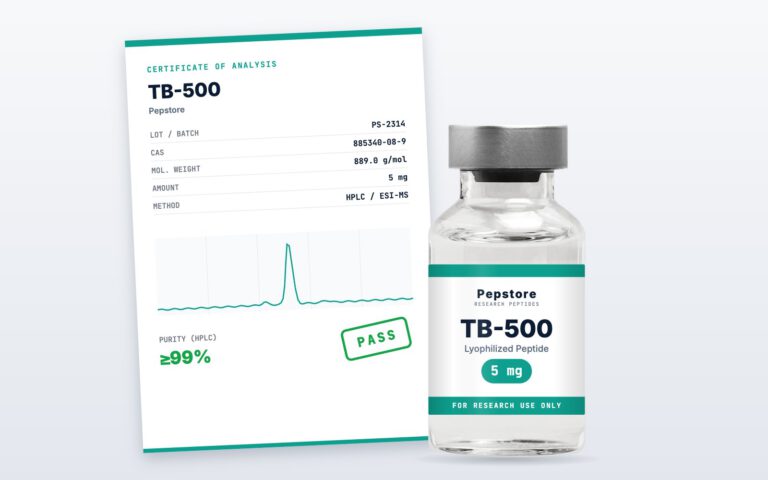

Purity describes how much of a sample is the intended peptide. Everything else — truncated sequences, deletion products, protecting-group remnants — counts as impurity.
Where impurities come from
Solid-phase synthesis builds a peptide one amino acid at a time. Each coupling step is highly efficient but not perfect, so a small fraction of chains end up missing a residue. Preparative HPLC removes most of these related substances.
Why purity matters
- Impurities can have their own biological activity and confound results
- Lower purity means less active compound per milligram weighed
- Batch-to-batch consistency depends on a tight purity specification
Reading our specification
Our catalogue peptides target ≥99% purity by HPLC. The exact result for every lot is on its certificate, alongside the mass-spectrometry identity check.